I've been playing with, and comparing, three different HDR conversion programs in an attempt to produce something palatable from Canterbury. I'm impressed by Photomatix, but the user interface is a bit clunky. The Nik "HDR Efex Pro" is much more refined, but more expensive (naturally). If I'm lucky I'll have worked out how to use it before the evaluation licence runs out...
First a couple of images I'd already tried using the Photoshop HDR converter.
Neither look particularly natural, I know, but that's partly deliberate. The rest of the images show the experimentation and learning I'm going through. Hopefully the results are improving slightly, but I'm yet to be totally convinced.
These images were all produced using Nik HDR Efex Pro, and then modified slightly in Lightroom for straightening and/or cropping. Not too bad, but still more experimentation is necessary, methinks...
Random postings from an itinerant engineer who would rather be taking pictures or catching trout on the fly...
Monday, 13 June 2011
Tuesday, 7 June 2011
Canterbury Cathedral
I spent the last three days in Kent with a group of people from Cambridge Camera Club, and part of that trip was a tour around Canterbury Cathedral on Saturday. I have barely started processing the images I took, but here are a few to be going on with. I decided that the location was an ideal place to learn about HDR (High Dynamic Range) photography, but these are very early days yet. As you can see below, some of the results are less than successful! I'm currently evaluating a couple of pieces of software for performing the HDR conversion and tone mapping, which explains the textual "watermark" in some of the pictures.
On the left is the "Exposure Fusion" version, which is much more natural but has failed to preserve details in the brightly lit wall. On the right is the overcooked version using classic HDR processing and tone mapping. Not sure the grungy look suits this particular image.
Another comparison with "natural" versus "OTT" processing. It's pictures on the right which get HDR a bad name, and it's not difficult to see why...
The picture of the pulpit works reasonably well in HDR, as it seems to fit with the vertical distortions caused by the 15mm fisheye lens. The treadmill is actually high up in the roof space of one of the Cathedral transepts, and was in almost complete darkness. Not sure I like the way I've processed it, so I'm sure I'll be coming back to this particular picture. An truly astonishing monument within a monument.
Here the overcooked look actually seems to suit the image rather well. Maybe it's the curved verticals which help to make the surreal processing more acceptable? This is probably my favourite HDR conversion to date, but it's clear I've got a long way to go yet. A book is on order from Amazon!
The last two images from this this first set are straight shots. On the left is a rather magnificent brass lectern. On the right is a the amazing ceiling of the tower, which had to be photographed from the middle of a treacherous flight of stairs. The shield in the middle is, apparently a trap-door.
Monday, 2 May 2011
More from Easter Sunday
A few more IR shots taken on Easter Sunday while playing tourist in Cambridge. As well as the obvious shots of King's College Chapel, I've included the picture of the Gibbs Building - not because it's a great image, but because it contains an unexpected ornithological specimen. A case of "what the duck"?
Then a walk along the backs from Kings College to Garret Hostel Lane. I loved the couple eating ice creams, who were also clearly enjoying some kind of private joke.
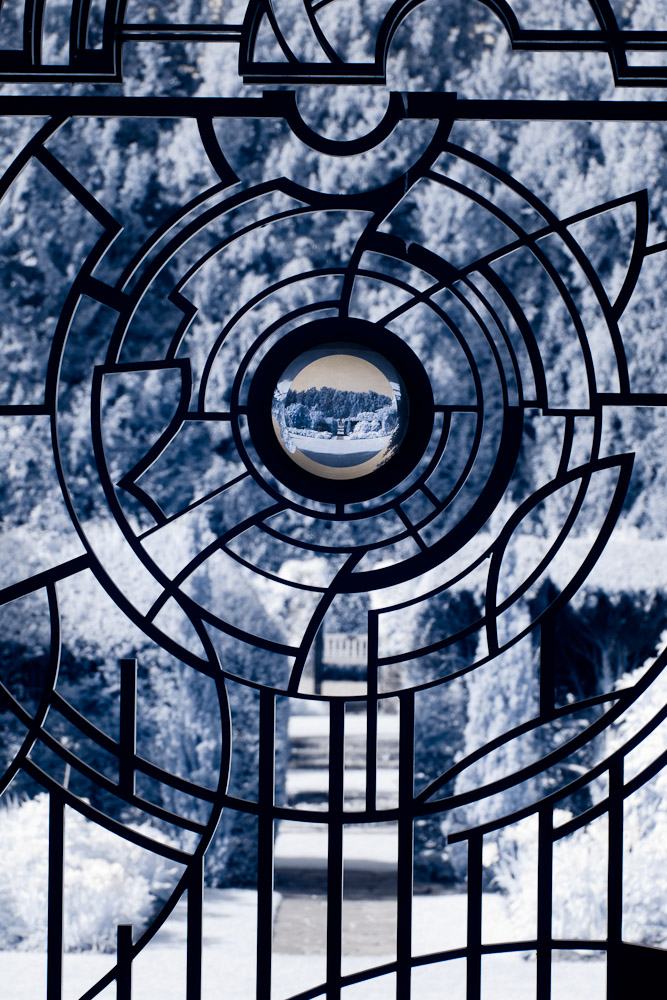
The final picture is the gate into Clare College gardens which contains a large lens in the centre.
Then a walk along the backs from Kings College to Garret Hostel Lane. I loved the couple eating ice creams, who were also clearly enjoying some kind of private joke.
The final picture is the gate into Clare College gardens which contains a large lens in the centre.
Saturday, 30 April 2011
Mucking about on the River
The last month has been very busy (as always) but I managed to get into Cambridge on Easter Sunday when my niece came to visit. It was the first time I've visited the normal tourist spots since my 20D was converted for IR, so I thought I'd give it a burn. This is a set of pictures I took from King's College Bridge of the River Cam, which was literally crawling with punts.
Friday, 25 March 2011
Spring Sunshine
The last couple of lunchtimes have been absolutely beautiful with lovely warm Spring sunshine. Time to dust off the IR camera again, as the soft muted colours seem to fit well with metallic modern architecture.
As an antidote to the stark concrete and aluminium,here's something a little more natural...
I need to revisit the daffodils before they start to die back.
As an antidote to the stark concrete and aluminium,here's something a little more natural...
I need to revisit the daffodils before they start to die back.
Tuesday, 22 March 2011
Ladybower Interpretations
Further to Frances's recent blog post, I think the picture of Ladybower could be interpreted successfully in many ways. Here are two more to add to the mix: a hard monochrome; and a soft, dreamy, colour version.
I think the second one is my favourite.
Monday, 14 March 2011
It's a Dog's Life
Spotted while walking to the Post Office this lunchtime.
Another attempt at playing with Silver Efex Pro 2.
Thursday, 10 March 2011
Checker Board
I treated myself to an X-Rite Color [sic] Checker Passport at Focus on Imaging on Tuesday. It's a very clever piece of kit indeed, and a huge amount of thought has gone into its design. The first test for it was to make a proper camera profile for my Panasonic LX3, as I've never been truly happy with the "Adobe Standard" version provided with ACR and Lightroom. Skies always used to have a cyan cast, and some reds were pushed towards yellow/orange.
Based on an experiment which took all of 2 minutes in the car park at work, the results are very impressive. All I did was to photograph the passport in daylight, then process the image in the Lightroom plugin which came with the product. Out pops a colour profile which can then be applied to other images, and I've included a selection here. In all cases, the original (Adobe) profile is on the left; the new (X-Rite) profile is on the right.
It's possible to make "joint" profiles from pictures taken under two completely different lighting conditions (e.g. daylight and tungsten). According to the documentation, this should improve the performance further in the sense that the profile generated should work for a greater variety of source images. It's also possible to make custom profiles for specific situations simply by including the passport in one of the RAW pictures taken under the same lighting conditions as the rest of the set. This should help enormously in colour-critical jobs, such as photographing paintings or quilting/textiles, or locations with mixed lighting such as church interiors.
I'll report further when I've had a chance to experiment with my other camera bodies...
Based on an experiment which took all of 2 minutes in the car park at work, the results are very impressive. All I did was to photograph the passport in daylight, then process the image in the Lightroom plugin which came with the product. Out pops a colour profile which can then be applied to other images, and I've included a selection here. In all cases, the original (Adobe) profile is on the left; the new (X-Rite) profile is on the right.
![]() |
| The ColorChecker Passport in action |
It's possible to make "joint" profiles from pictures taken under two completely different lighting conditions (e.g. daylight and tungsten). According to the documentation, this should improve the performance further in the sense that the profile generated should work for a greater variety of source images. It's also possible to make custom profiles for specific situations simply by including the passport in one of the RAW pictures taken under the same lighting conditions as the rest of the set. This should help enormously in colour-critical jobs, such as photographing paintings or quilting/textiles, or locations with mixed lighting such as church interiors.
I'll report further when I've had a chance to experiment with my other camera bodies...
Thursday, 3 March 2011
Experiments with Silver Efex Pro 2
I blame Ann for this (naturally) but I downloaded the demo version of Nik Silver Efex Pro 2 yesterday. This lunchtime was spent watching a number of tutorial videos, followed by a decision to "have a go". All the pictures below were taken at the Black Country Museum on a miserably cold, wet day in December 2009. They are all full-frame shots (i.e. no cropping or rotation) and none of the B&W conversions took longer than 5 minutes to perform. I have to say that I'm dead impressed so far, but then I haven't shelled out any hard-earned dosh yet. I might have to, though, especially as version 2 has some superb features which make it much more flexible and easier to use than version 1.
Wednesday, 9 February 2011
IR close to work
Camera Club duties have, again, taken their toll when it comes to my own photography since Christmas. That's life, unfortunately. I did have the chance to wander around with my new IR camera one lunchtime last week, however, and these are the results.
My office is just around the corner from Cambridge Airport, hence the picture above.
The "greasy spoon" caravan is just outside the Airport perimeter fence, and directly opposite a large Mercedes dealership. Usually this means that there is no shortage of takers for its wares. Because of the red filter in the IR camera, the "NO ENTRY" sign has been rendered almost invisible. The second picture is a local "tyre, brake and exhaust" outfit, and the chap shown was simply basking in the early February sun.
The final four pictures are of the Mercedes dealership, which has just had a shiny new aluminium cladding fitted - presumably as this will make people spend even more on their outrageously expensive cars. Interestingly, the flags in the last shot genuinely were blue; but then so was the sky. That's one of the things I love about IR photography, as it's not always possible to predict the outcome.
Subscribe to:
Posts (Atom)