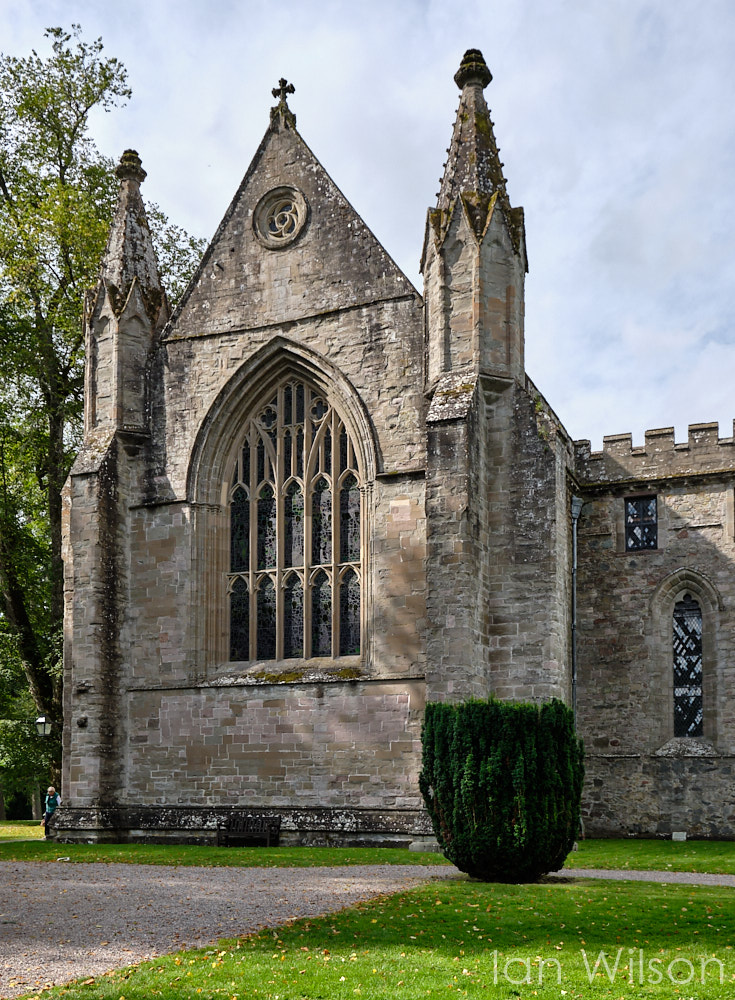
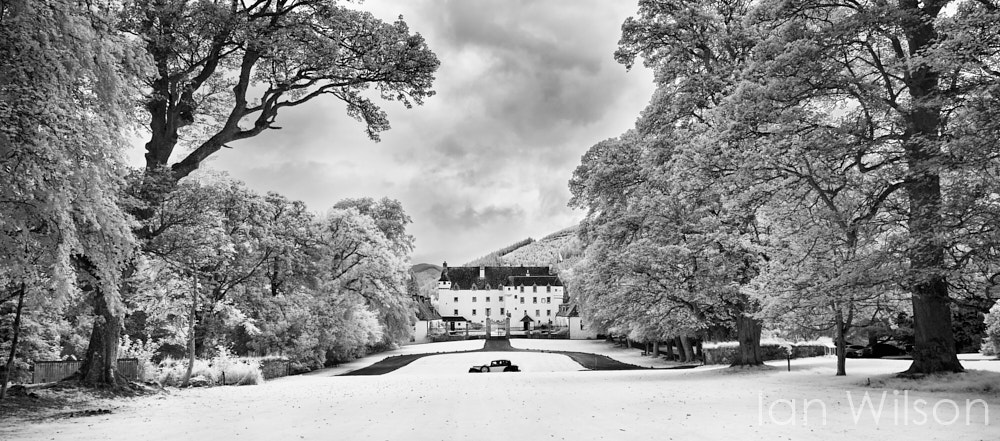
Our time in Fife was over, with the next stop being Pitlochry. The journey took us back through St Andrews, over the Tay Bridge to Dundee, then around Perth and north up the A9. Lunchtime happened to correspond with the town of Dunkeld, so we decided to stop off and take a look. Dunkeld is small and very attractive, with several shops and eateries (including an excellent bakery where we bought bridies and cake) . It also boasts a part-ruined "Cathedral" - really not much more than a parish church - which has quite a chequered history. The Battle of Dunkeld was part of the 1689 Jacobite rising, supporting the deposed James VII of Scotland against William of Orange. As a result of the battle, the Cathedral has lots of holes caused by musket fire which are clearly visible today.
Dunkeld is a lovely place, and is thoroughly recommended for anyone who needs a bit of respite on the long drive north. I'm sure we'll be back there at some point.
Random postings from an itinerant engineer who would rather be taking pictures or catching trout on the fly...
Showing posts with label Infra-Red. Show all posts
Saturday, 21 December 2019
Tuesday, 3 December 2019
Scotland 2019 9: Thirlestane Castle
After three days exploring the Scottish Borders it was time to move on to our next destination: Fife. Looking at the map it was clear that the scenic route towards Edinburgh would take us past Thirlestane Castle, so we decided to pay it a visit. Thirlestane is the home of the Earls and Duke of Lauderdale, and has been in the hands of the Maitland family since 1590. A large baronial pile built from red sandstone, it looked very impressive in its own grounds. The fact that some of those grounds are now given over to a Caravan Park is a bit of a shame, but I guess it's better than selling the family silver or a series of Old Masters...
The dining room was probably the grandest of all, with an ornate ceiling plus paintings of both family and royalty. It also included a disembodied sheep's head on the table; and, being on wheels, it was clearly more than simple "decoration". A holder for a Port bottle, perhaps?
Probably the most astonishing thing we found at Thirlestane was tucked away on a shelf in a display cabinet. The custodian very kindly allowed me to move it to a location with better light so that I could photograph it for posterity. The item in question is a plaque which was presumably given as a prize to Viscount Maitland by Cambridge & District Photographic Club (now Cambridge Camera Club) in 1906. This was only four years after the club was founded, but how it came to be presented remains a mystery. The custodian, who knew the family history well, wasn't able to explain why the Viscount would have been in Cambridge at this time. He didn't study at the University, as far as anyone knows, so perhaps his army regiment was stationed near the town? However it came into his possession, it was still good to see a small part of the club's heritage so well looked after.
The interior was spacious and grand (in stark contrast to Traquair) with the obligatory billiard room, library, ornate bedrooms and the like.
The dining room was probably the grandest of all, with an ornate ceiling plus paintings of both family and royalty. It also included a disembodied sheep's head on the table; and, being on wheels, it was clearly more than simple "decoration". A holder for a Port bottle, perhaps?
Probably the most astonishing thing we found at Thirlestane was tucked away on a shelf in a display cabinet. The custodian very kindly allowed me to move it to a location with better light so that I could photograph it for posterity. The item in question is a plaque which was presumably given as a prize to Viscount Maitland by Cambridge & District Photographic Club (now Cambridge Camera Club) in 1906. This was only four years after the club was founded, but how it came to be presented remains a mystery. The custodian, who knew the family history well, wasn't able to explain why the Viscount would have been in Cambridge at this time. He didn't study at the University, as far as anyone knows, so perhaps his army regiment was stationed near the town? However it came into his possession, it was still good to see a small part of the club's heritage so well looked after.
Wednesday, 6 November 2019
Scotland 2019 2: Traquair Exteriors
First stop in Scotland was an old fashioned, and rather eccentric, guest house on the outskirts of Galashiels. Eating dinner on the first night, we accosted the waiter and asked about places worth visiting in the area, in addition to the obvious Border Abbeys. The answer was unequivocal: we must go to Traquair (pronounced "Trah-Queer"), which is the oldest continuously inhabited house in Scotland. The house dates back to 1107, and has been lived in by the Start family since 1491. Always staunchly Catholic, it has played host to 27 Scottish kings and queens, including Mary Queen of Scots. It also hosted Bonnie Prince Charlie prior to the 1745 Jacobite rebellion; and, on leaving, he gave instructions that the great Bear Gates should be locked behind him and not opened again until there was a Stuart on the British throne. Needless to say they're still locked...
Before going into the house, we went for a walk around the walled garden. It was dull and drizzly, but this also meant that we were the only ones there.
It's clear from the amount of lichen on this apple tree quite how damp this part of the world gets.
Because Traquair has always been Catholic, its inhabitants spent a very long time out of favour with the British monarchy. This meant that the family were relatively poor, so couldn't afford to renovate or "improve" the building, especially during the Victorian era. As a result the house is completely unspoiled, and - apart from the two wings - pretty much as it was originally built.
The building above houses the Traquair Brewery, which is responsible for producing several highly potent beverages. It originally produced beer for the family, but was resurrected as an experiment in the early 1960s by the 20th Laird, Peter Maxwell Stuart. It's now very much a going concern, and helps to supplement the house's income (along with being the most amazing wedding venue).
It's clear from the amount of lichen on this apple tree quite how damp this part of the world gets.
Because Traquair has always been Catholic, its inhabitants spent a very long time out of favour with the British monarchy. This meant that the family were relatively poor, so couldn't afford to renovate or "improve" the building, especially during the Victorian era. As a result the house is completely unspoiled, and - apart from the two wings - pretty much as it was originally built.
Location:
Traquair, Innerleithen EH44 6PH, UK
Tuesday, 5 November 2019
Scotland 2019 1: Bowness to Hermitage Castle
In the middle of August, Harriet and I set of for this year's odyssey. Not Iceland (too bleeping expensive, having gone last year) but sunny Scotland instead. Three days each in five different areas, some of which we knew but others being new territory. Brace yourselves for another long and tedious travelogue, in other words.
We broke the journey north by staying with friends for a night in Bowness-on-Windermere. There are no pictures from the first day as it was wall-to-wall rain, high winds and very poor visibility. The storm had just about cleared by the second day, though, and we went for a short walk along the lake shore before heading off.
The original plan had been to visit one of the many Roman forts along Hadrian's Wall, but the weather was so changeable that we decided to take the scenic route to The Borders instead (A7). By lunchtime we had reached Langholm, so it seemed as good a place as any to stop.
I'd no idea that Nancy Pelosi had relatives in Scotland, but they know how to make a mean (and cheap) toastie.
Everywhere has its claim to fame, but it seems that Neil Armstrong (no less) now considers Langholm to be his home town. Well, he did in 1972 anyway, but may have had second thoughts since.
The light was sunny and harsh with fluffy white clouds, so I decided to use the Infra-Red camera for most of the afternoon. Even Langholm looks spectacular in IR...
Back in 1980 I visited the Scottish Borders with some friends from University, just after graduation, and we stopped at Hermitage Castle on the way up. The weather was cold, damp and dreary on that occasion, and I remember Hermitage as being in the middle of absolutely nowhere. Well, it's still in the middle of nowhere, but at least the weather was a bit kinder this time. Hermitage is an enormous monolith, and IR was able to bring out some of its darker side.
A short walk from the castle are the remains of an old chapel, which I hadn't visited before. Not a lot to see, but a good view back to the castle itself.
We broke the journey north by staying with friends for a night in Bowness-on-Windermere. There are no pictures from the first day as it was wall-to-wall rain, high winds and very poor visibility. The storm had just about cleared by the second day, though, and we went for a short walk along the lake shore before heading off.
The original plan had been to visit one of the many Roman forts along Hadrian's Wall, but the weather was so changeable that we decided to take the scenic route to The Borders instead (A7). By lunchtime we had reached Langholm, so it seemed as good a place as any to stop.
I'd no idea that Nancy Pelosi had relatives in Scotland, but they know how to make a mean (and cheap) toastie.
Everywhere has its claim to fame, but it seems that Neil Armstrong (no less) now considers Langholm to be his home town. Well, he did in 1972 anyway, but may have had second thoughts since.
The light was sunny and harsh with fluffy white clouds, so I decided to use the Infra-Red camera for most of the afternoon. Even Langholm looks spectacular in IR...
Back in 1980 I visited the Scottish Borders with some friends from University, just after graduation, and we stopped at Hermitage Castle on the way up. The weather was cold, damp and dreary on that occasion, and I remember Hermitage as being in the middle of absolutely nowhere. Well, it's still in the middle of nowhere, but at least the weather was a bit kinder this time. Hermitage is an enormous monolith, and IR was able to bring out some of its darker side.
A short walk from the castle are the remains of an old chapel, which I hadn't visited before. Not a lot to see, but a good view back to the castle itself.
For reference, here are a couple of colour pictures showing the castle and the chapel. Somehow they look rather benign in the August sunshine, which wasn't really the atmosphere I was trying to convey. The first image shows Harriet on the grass, and hopefully this gives some idea of the castle's scale.
Hermitage Castle is situated in the area hit by the Border Reivers, who must have been a real thorn in the side for the residents at the time. In 1524 the Archbishop of Glasgow became so exasperated with the activities of the Reivers that he issued a "Monition of Cursing" (nowadays we'd call it a rant) against them. Part of his curse is reproduced on the Castle's information board.
Not easy to read, but it makes slightly more sense when spoken aloud (i.e. phonetically). I particularly love the way he wanted to "curse thair wiffis", since - presumably - the lack of an Internet connection might slow the Reivers down a bit.
Location:
Newcastleton, Hawick TD9 0LU, UK
Subscribe to:
Posts (Atom)