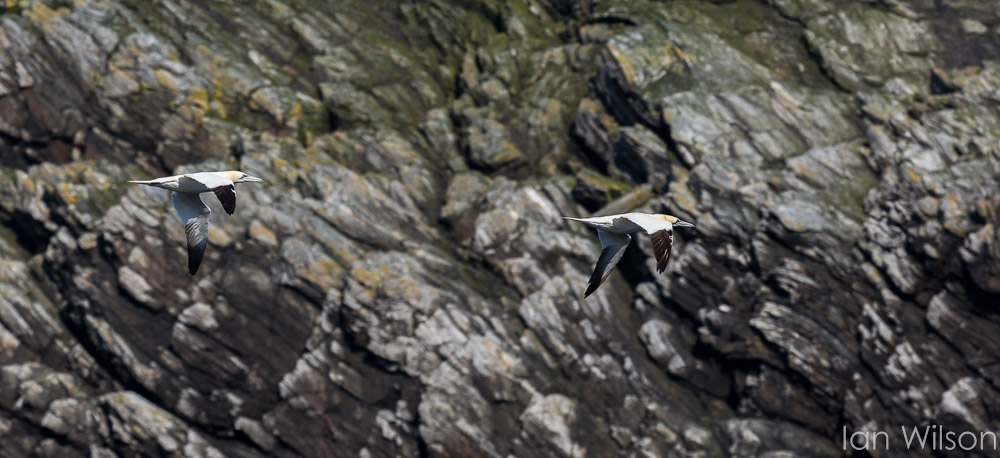
After all that airy-fairy camera waving, I though it was time for a bit of proper photography: namely, some of the birds we saw at the Butt of Lewis. The Northernmost tip of Lewis boasts an iconic lighthouse and cliffs which are home to plenty of gulls and fulmars. Given its location, it's also on the flight-path for gannets between St Kilda and the Scottish mainland, so is a great place to watch the birds as they come and go.
No, there aren't any birds in that first picture: it was just a test to see if you were paying attention! I also included it to give a sense of the craggy cliffs (yet more Lewisian Gneiss) and the vegetation which grows on them.
Looking closer it was possible to see fulmars nesting in the cliffs opposite. The constant bickering and guano-streaked surroundings were a bit of a give-away.
A few pictures of gannets, gulls (herring and greater black-backed) and fulmars as they flew around the cliffs. It was a beautiful, sunny day and I could have stayed there for hours watching these graceful creatures.
I wasn't the only one, as Harriet was in bird-watchers' heaven.
This is the Butt of Lewis lighthouse. Not especially attractive in itself, but obviously a very welcome site for a string of cyclists as they arrived having completed the Hebridean Way: a scenic ride from Vatersay in the South to the very tip of Lewis in the North. All uphill too...
By lunchtime the West side of Lewis was covered in a blanket of thick fog, so we drove back across the Barvas moor to Stornoway, determined to visit the town while it was open! The two highlights were By Rosie, a shop giving a very modern twist on traditional Harris Tweed, and the Lewis Loom Centre which we'd attempted to visit on Sunday. The home-made signs were a sight to behold, and we're still not quite sure which animal they're supposed to depict. Sheep, presumably, but we didn't spot any mutants like these anywhere on our travels.
The Loom Centre itself looked (slightly) less derelict than it had done a week beforehand, but it was obviously doing a roaring trade. The interior was a veritable Aladdin's Cave of Harris Tweed in all shapes, sizes and colours: a bit like a sweet shop for textile artists like Harriet. The only problem was deciding which bits of cloth to buy, and this took a little while. On the plus side, I now know what a "fat quarter" is.
Since we had a very early start the following morning, it was then time to head back to the house to pack everything up and load the car ready for the journey home. Time to contemplate returning to reality, unfortunately.
Random postings from an itinerant engineer who would rather be taking pictures or catching trout on the fly...
Tuesday, 7 October 2014
Monday, 6 October 2014
Hebrides 30: Port of Ness
Given that the weather forecast promised one last fine day, we decided to head to the Butt of Lewis: the Northern-most tip of the island. The light was beautiful in Lemreway before we set off, though, so I thought I'd make a panorama of the view from our front door.
The journey involved driving through Stornoway, across the Barvas Moor, and then through several tiny villages until - eventually - we reached Port of Ness (or Port Nis as it is in the Gaelic). Incidentally, we were gradually getting the hang of deciphering the road signs, which in this part of the world are only in Gaelic. Unfortunately, the maps we had with us (courtesy of Cambridge University Geography Department) were in English, dating from long before Scottish independence became such a hot topic.
While driving around Lewis, we occasionally encountered items which looked like Trolls' picnic tables. These are enormous Stonehenge-like structures, to be found strategically positioned at road junctions. Eventually we twigged that they were bus shelters, offering temporary respite from the Hebridean wind and rain, no matter which direction the weather was coming from!
Port of Ness is a small, sleepy town, just South of the Butt, and formed the basis for the fictitious town of Crobost in Peter May's Lewis trilogy.
Pleasant enough, but the bright, contrasty conditions weren't ideal for photography. Based on my experiences at Luskentyre and Uig Sands, it seemed a good idea to see whether something similar would work on the sea and cliffs. To me there's a beautiful simplicity in the abstract forms created by the camera movement, and the technique certainly does a good job of dealing with the extremes of contrast. Each to their own, I suppose.
Apologies if you're bored stupid with me waving the camera around. I promise you that this is the final set of the trip!
Having exhausted what Port of Ness had to offer, and failing to buy an ice cream from Schrodingers Cafe (which appeared to exist in a state of being both open and shut at the same time), we headed off for the lighthouse and seabird colonies at the Butt of Lewis itself. Look out for the next inimitable instalment...
Subscribe to:
Posts (Atom)


