Puffins weren't the only birds at Ingólfshöfði, of course, and plenty of gulls were also in evidence: mainly great black-backed and fulmars, but we also saw the occasional kittiwake.
Ingólfshöfði is usually a safe breeding area for ground-nesting species: especially great skuas (bonxies) which have a large colony there. The sheer scale of the sandur separating the rock from the mainland means that predators, such as arctic foxes, are kept well away. This was certainly the case in 2013, and we had to be careful not to tread on bonxie nests while, at the same time, suffering an aerial bombardment from the chicks' parents.
In 2015 a pair of arctic foxes managed to make the crossing, and this spelt disaster for the bonxies. Their first brood was totally wiped out, as the foxes used the plentiful supply of food to raise a large litter of pups. They then attempted a second brood, but this too was also completely obliterated. Not one chick survived, and the parents didn't try a third time. As a result, all the adult bonxies were - effectively - standing around, twiddling their thumbs. They had no young to feed and no nests to protect, meaning that the usual aggressive behaviour was completely absent. All desperately sad, although I'm sure the family of arctic foxes (now, thankfully, removed) didn't see it that way.
There were precious few seabirds on the cliffs, so we eventually walked back to the escarpment past the sheep hut. It looked very dramatic with Vatnajökull as a backdrop.
Going down the sand slope was significantly easier than going up it, and then it was all aboard the tractor for the ride back to base. As with our previous trip, the visit to Ingólfshöfði was definitely one of the highlights of the holiday, and it really should be on the itinerary of anyone who is visiting this part of Iceland.
Random postings from an itinerant engineer who would rather be taking pictures or catching trout on the fly...
Friday, 12 February 2016
Iceland 2.30: Ingólfshöfði 2
Labels:
Birds,
Gulls,
Iceland,
Ingólfshöfði,
Skuas
Location:
Ingólfshöfði, Iceland
Thursday, 11 February 2016
Iceland 2.29: Ingólfshöfði 1
Sadly we'd only booked to stay a single night at the Hali Country Hotel, which - with hindsight - was a real pity. It really was excellent, and we very much hope to go back there at some point in the future. Thoroughly recommended, unlike the rather odd place we ended up the following night. I mustn't get ahead of myself, however...
We had been to Ingólfshöfði on our previous visit in 2013, and knew it was an absolute must given that we were in the area. The weather was very windy but also bright and sunny - completely different to the rain and low cloud which had accompanied our previous visit. Ingólfshöfði is a volcanic outcrop which is now in the middle of a sandur about 6km from the mainland. It was named by Ingólfr Arnarson, the first viking to visit Iceland in the year 874, since it was where he landed after his journey from Norway. As well as having historical significance, it is also one of the best locations to see breeding puffins and great skuas in the whole of Iceland.
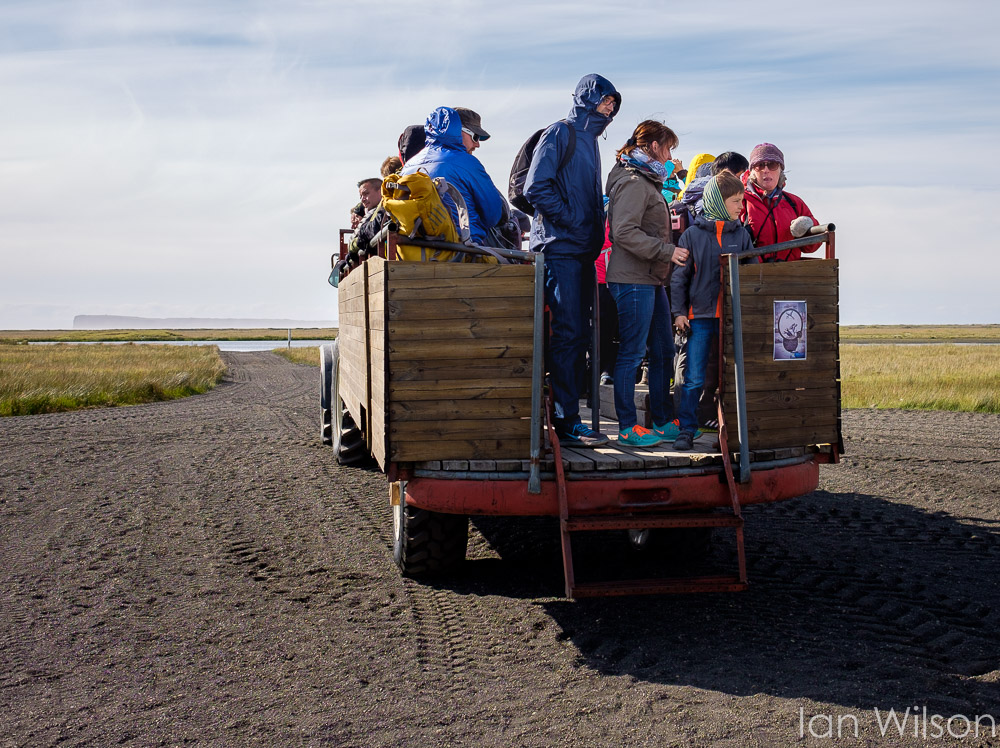
A local farmer takes visitors across the sands in a tractor and converted hay trolley, and his nephew Aron - a naturalist - guides them through the impressive bird colonies on the isolated rock.
The view back to Vatnajökull was crystal clear because of the strong winds. The conditions had also dried the sands, which made for interesting driving (and, later, walking).
The tractor dropped us at the foot of an escarpment, and our first job was to get to the top. On our previous visit the sand had been damp; and, although arduous, the climb was reasonably straightforward. The lack of moisture meant that ascending the slope was well nigh impossible: two steps up, two steps back, as we all slithered around in the extremely dry sand.
Eventually the whole group did manage to get to the top, and the view back was absolutely stunning. Hopefully the picture with Vatnajökull and the tractor will give some kind of scale to this truly majestic place.
There is a memorial stone at the top of the hill with an inscription from the Landnámabók: a history of the settlement of Iceland. Loosely translated it says: Ingolfr took this land and called it Ingólfshöfði.
Once we'd got our breath back we started to see puffins heading off to sea and then returning to their burrows with beaks full of sand eels. It's not surprising that they're everyone's favourite bird, and I was amused to discover that the Icelanders call them "sea parrots".
I could have spent hours in just one spot photographing the puffins, but sadly we needed to move on to look at other things.
We had been to Ingólfshöfði on our previous visit in 2013, and knew it was an absolute must given that we were in the area. The weather was very windy but also bright and sunny - completely different to the rain and low cloud which had accompanied our previous visit. Ingólfshöfði is a volcanic outcrop which is now in the middle of a sandur about 6km from the mainland. It was named by Ingólfr Arnarson, the first viking to visit Iceland in the year 874, since it was where he landed after his journey from Norway. As well as having historical significance, it is also one of the best locations to see breeding puffins and great skuas in the whole of Iceland.
A local farmer takes visitors across the sands in a tractor and converted hay trolley, and his nephew Aron - a naturalist - guides them through the impressive bird colonies on the isolated rock.
The view back to Vatnajökull was crystal clear because of the strong winds. The conditions had also dried the sands, which made for interesting driving (and, later, walking).
The tractor dropped us at the foot of an escarpment, and our first job was to get to the top. On our previous visit the sand had been damp; and, although arduous, the climb was reasonably straightforward. The lack of moisture meant that ascending the slope was well nigh impossible: two steps up, two steps back, as we all slithered around in the extremely dry sand.
Eventually the whole group did manage to get to the top, and the view back was absolutely stunning. Hopefully the picture with Vatnajökull and the tractor will give some kind of scale to this truly majestic place.
There is a memorial stone at the top of the hill with an inscription from the Landnámabók: a history of the settlement of Iceland. Loosely translated it says: Ingolfr took this land and called it Ingólfshöfði.
Once we'd got our breath back we started to see puffins heading off to sea and then returning to their burrows with beaks full of sand eels. It's not surprising that they're everyone's favourite bird, and I was amused to discover that the Icelanders call them "sea parrots".
I could have spent hours in just one spot photographing the puffins, but sadly we needed to move on to look at other things.
Labels:
Birds,
Iceland,
Ingólfshöfði,
Puffins,
Vatnajökull
Location:
Ingólfshöfði, Iceland
Subscribe to:
Posts (Atom)